
Gym Waivers & Member Onboarding: January 2026 Guide
96M Americans join gyms in January but 50% quit. Digital waivers and seamless onboarding boost retention by 35%. Complete checklist inside.
Formfy Team
Product Team
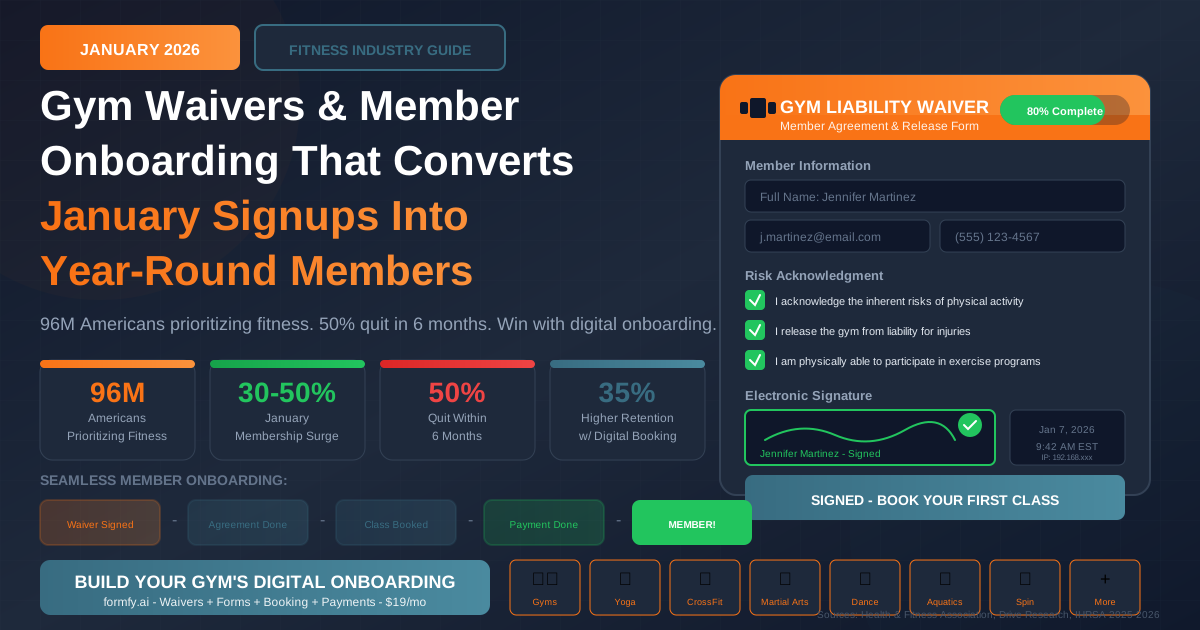
Right now—this week—gyms across America are experiencing their biggest membership surge of the year. 96 million adults are prioritizing fitness in 2026, according to the Health and Fitness Association. The treadmills are packed. The weight rooms are crowded. Front desks are overwhelmed with new signups.
But here's the harsh reality that every gym owner knows: 50% of these new members will quit within 6 months. Even worse, 23% won't make it past the first week. By the end of January, 43% will have already abandoned their New Year's resolutions.
The difference between gyms that retain members and gyms that watch them walk away often comes down to one thing: the first five minutes.
Gyms with seamless digital onboarding achieve 35% higher retention than those still shuffling paper waivers. They convert the January rush into year-round revenue. They turn resolution-makers into fitness lifers.
The problem? Most fitness businesses still rely on paper liability waivers that create bottlenecks, manual scheduling that frustrates new members, and disconnected payment systems that add friction at the worst possible moment—when a motivated new member is ready to commit.
This guide covers everything you need to convert January signups into year-round members: digital waivers that protect your business, onboarding workflows that create instant engagement, and the complete forms checklist every fitness business needs in 2026.
Who this guide is for:
- Gym owners and managers
- Fitness studio operators
- Yoga and Pilates studios
- CrossFit box owners
- Personal trainers
- Martial arts schools
- Dance studios
- Boutique fitness concepts
- Wellness centers
96 Million Americans Just Made Fitness a Priority—Is Your Gym Ready?
The January 2026 fitness surge isn't just anecdotal. The numbers are staggering:
- 96 million U.S. adults plan to prioritize health, fitness, or exercise in 2026 (Health and Fitness Association)
- 48% of Americans say improving fitness is their top priority for 2026 (Drive Research)
- 79% of New Year's goals involve improving health
- 30-50% spike in gym memberships happens every January
- 12% of all annual gym sign-ups occur in January alone—more than any other month
This isn't just a busy season. January represents a make-or-break month for annual revenue. Each member you retain generates $300-$600+ in annual value depending on your membership pricing.
Let's do the math on what retention means for a gym that signs 100 new members this January:
| Retention Rate | Members Retained | Annual Value ($50/mo) | Annual Value ($100/mo) |
|---|---|---|---|
| Traditional (50% quit) | 50 members | $15,000 | $30,000 |
| High retention (71%) | 71 members | $21,300 | $42,600 |
| Difference | +21 members | +$6,300 | +$12,600 |
That's potentially $12,600 in additional annual revenue per 100 January signups—just by improving retention from average to above-average.
The January Challenge
But January presents unique operational challenges:
- Front desks are overwhelmed with new members signing up
- Paper waivers create bottlenecks that frustrate motivated members
- Manual data entry leads to errors that cause problems later
- New members waiting = bad first impressions that start the relationship poorly
- Frustrated staff = poor member experience that compounds throughout the month
The gyms winning in January 2026 aren't just processing more signups—they're creating better first impressions that lead to long-term retention.
The First 5 Minutes: Why 50% of New Members Never Come Back
The statistics on gym member attrition are sobering:
- 23% quit by end of the first week
- 43% quit by end of January
- 50% quit within 6 months
- 67% rarely or never use their memberships
- Only 9% of Americans who make resolutions actually achieve them (Ohio State University)
But why do so many members quit so quickly? The research points to several root causes:
1. Friction at Signup
Long waits, confusing paperwork, and overwhelmed staff create a negative first impression. When a motivated new member has to wait 15-20 minutes to fill out paper forms, their enthusiasm starts to fade before they even touch a piece of equipment.
2. No Immediate Engagement
Members who don't book their first class or orientation during signup are significantly less likely to return. Without a scheduled appointment, it's too easy to say "I'll come back tomorrow" indefinitely.
3. Lost in the Shuffle
During the January rush, new members can feel like just another number. Without personalized follow-up, they don't feel valued or accountable to anyone.
4. Intimidation Factor
New members often don't know how to use equipment properly. Without an orientation or introduction, the gym floor feels overwhelming. It's easier to quit than to feel embarrassed.
5. No Built-in Accountability
Without scheduled appointments or classes, there's nothing holding members accountable. Skipping one day becomes two days becomes a week becomes a canceled membership.
The Digital Difference
Here's where digital onboarding changes everything:
- 30-50% faster onboarding creates a better first impression
- Instant class booking creates immediate engagement
- Automated follow-ups ensure consistent communication
- Easy scheduling builds accountability into the membership
The key insight: Members who attend group fitness classes are 56% less likely to cancel their membership. But they can only attend if booking is easy enough to do during signup.
Gym Liability Waivers: What Every Fitness Business MUST Include
What is a gym liability waiver? A gym liability waiver is a legal document that members sign acknowledging the risks of physical activity and agreeing not to hold the gym liable for injuries. Digital waivers with e-signatures are legally binding under the ESIGN Act (2000) and UETA (Uniform Electronic Transactions Act), adopted by 49 states.
Every fitness business needs a properly structured liability waiver. Here's what must be included:
1. Assumption of Risk
The member must acknowledge that physical activity carries inherent risks. This section should specifically mention:
- Equipment injuries (weights, machines, cardio equipment)
- Slips, trips, and falls
- Overexertion and physical strain
- Cardiovascular events
- Injuries from other members
- Risks specific to your facility (pool, sauna, etc.)
The language should be clear and specific. Courts have ruled that vague or overly broad assumption of risk clauses may not be enforceable.
2. Release of Liability
This is the core of the waiver—the member agrees not to hold the gym liable for injuries that occur during their participation. Key elements:
- Clear statement releasing the gym from liability
- Coverage of negligence (where permitted by state law)
- Extension to employees, trainers, and staff
- Coverage of future claims, not just present
3. Health Acknowledgment
Members should confirm their fitness to participate:
- Declaration that they are physically capable of exercise
- Recommendation to consult a physician before starting a fitness program
- Acknowledgment that they have disclosed any relevant medical conditions
- Understanding that they should stop exercising if they feel unwell
4. Rules and Policies Acknowledgment
Include acceptance of your facility rules:
- Equipment usage guidelines and gym etiquette
- Dress code requirements
- Hygiene policies (wiping equipment, shower requirements)
- Age restrictions and supervision policies
- Guest policies
5. Media Release (Optional)
If you take photos or videos for marketing:
- Permission to photograph/record the member
- Permission to use images in marketing materials
- Social media posting consent
- Option to opt out while still signing the waiver
6. Signature Fields
For legal validity, capture:
- Member's full legal name (typed or printed)
- Member's signature (drawn or typed)
- Date of signing
- For digital waivers: timestamp, IP address, and device information
For members under 18, you must include a parent or guardian signature.
Legal Validity of Digital Waivers
Digital waivers are legally binding under:
- ESIGN Act (2000) — Federal law making electronic signatures legally equivalent to handwritten signatures
- UETA — Adopted by 49 states (all except New York, which has similar legislation)
For a digital signature to be valid, you must capture:
- Intent to sign (clicking a signature button or drawing a signature)
- Association with the document being signed
- Record retention (the signed document must be stored and retrievable)
Formfy captures all of this automatically, plus provides an audit certificate with every signed document showing timestamp, IP address, and browser information.
State-Specific Considerations
Waiver enforceability varies by state:
- Some states limit the types of claims that can be waived
- Gross negligence typically cannot be waived anywhere
- Some states require specific language or formatting
- Minor waivers have additional requirements in many states
Important: Consult with an attorney licensed in your state to ensure your waiver meets local requirements.
The Complete Gym and Fitness Business Forms Checklist
Beyond liability waivers, fitness businesses need a comprehensive set of forms. Here's the complete checklist:
Pre-Membership (Lead Capture)
- Website inquiry form — Capture leads from your website
- Trial pass request — Offer free trials with contact capture
- Tour scheduling form — Let prospects book facility tours
- Free consultation booking — Personal training consultations
Membership Signup (Essential)
- Liability waiver / Release of claims — Legal protection (required)
- Membership agreement / Contract — Terms, pricing, cancellation policy
- Health questionnaire (PAR-Q) — Physical Activity Readiness Questionnaire
- Emergency contact form — Who to call in case of emergency
- Payment authorization — Auto-billing consent and payment details
- Photo/video release — Marketing permission (optional)
For Minors (Under 18)
- Parent/guardian consent form — Required for all minor members
- Minor liability waiver — With guardian signature
- Medical authorization form — Permission to seek medical treatment
- Emergency contact — Parent plus alternate contact
Personal Training
- Personal training waiver — Additional liability coverage
- Fitness assessment form — Baseline measurements and goals
- Goal setting questionnaire — Detailed fitness objectives
- Training agreement / Package contract — Session terms and pricing
- Cancellation/reschedule policy — No-show and late cancel terms
Group Classes
- Class registration form — Sign up for specific classes
- Class-specific waivers — Yoga, spin, HIIT, etc.
- Specialty class consent — Aerial yoga, boxing, etc.
Specialty Studios
Different fitness businesses need specialized waivers:
CrossFit Boxes:
- High-intensity training acknowledgment
- Olympic lifting risk disclosure
- Competition/event waivers
Yoga Studios:
- Physical adjustment/hands-on consent
- Hot yoga health acknowledgment
- Pregnancy modifications disclaimer
Martial Arts Schools:
- Sparring consent
- Contact training acknowledgment
- Tournament/competition waivers
Dance Studios:
- Performance participation consent
- Recital waivers
- Costume/uniform agreements
Swimming/Aquatics:
- Drowning risk acknowledgment
- Supervision requirements
- Pool rules and diving restrictions
Ongoing Operations
- Guest pass waiver — For members bringing guests
- Day pass agreement — Non-members paying per visit
- Equipment rental agreement — Locker, towel, etc.
- Membership freeze request — Pause membership
- Cancellation request form — Membership termination
- Feedback/complaint form — Member satisfaction tracking
Paper Waivers vs Digital Waivers: Why Modern Gyms Have Made the Switch
The fitness industry has been slower to adopt digital waivers than other industries. But the gyms that have made the switch consistently report transformative results.
The Paper Problem
Paper waivers create operational headaches:
- Filing cabinets full of documents taking up valuable space
- Lost or damaged waivers creating liability exposure
- Manual data entry required to get information into your systems
- Hours spent searching for specific member documents
- Compliance risks with disorganized records
- Front desk bottlenecks during busy periods like January
The Digital Advantage
| Metric | Paper Waivers | Digital Waivers | Impact |
|---|---|---|---|
| Onboarding time | 8-15 minutes | 2-5 minutes | 30-50% faster |
| Storage cost | Filing cabinets, space | Cloud-based, $0 | Eliminates overhead |
| Searchability | Manual search | Instant search | Hours saved |
| Loss rate | 5-10% misplaced | 0% (backed up) | 100% document retention |
| Insurance claims | Dig through files | Instant retrieval | Faster resolution |
| Audit compliance | Manual organization | Automatic | Always compliant |
| Environmental impact | Paper waste | Paperless | Sustainable |
| Member experience | Wait in line | Sign before arriving | Better first impression |
Pre-Arrival Onboarding: The Game Changer
The biggest advantage of digital waivers isn't just speed—it's when the signing happens.
With digital waivers, you can:
- Send the waiver link via email or text before the member's first visit
- Member completes forms at home on their own schedule
- They arrive ready to work out immediately
- No front desk wait means better first impression
- Staff can focus on engagement rather than paperwork
During January, this means the difference between a 20-minute wait to start working out and walking in ready to exercise. That's often the difference between a member who stays and a member who quits.
How to Build a 5-Minute Member Onboarding System with Formfy
Here's a step-by-step guide to creating a seamless digital onboarding workflow that takes new members from signup to their first workout in under 5 minutes.
Step 1: Create Your Liability Waiver (10 minutes)
- Log into Formfy and use the AI wizard: describe "gym liability waiver"
- Add a signature field for the member
- Add a parent/guardian signature field (for handling minors)
- Add date and initials fields for key clauses
- Include a health acknowledgment checkbox
- Preview and test the form
Step 2: Build Your Membership Agreement (10 minutes)
- Upload your existing contract PDF, OR build from scratch in the visual editor
- Add payment terms and auto-renewal disclosure
- Include cancellation policy (clearly stated)
- Add initial fields for important clauses
- Signature field at the bottom
Step 3: Create Health Questionnaire (5 minutes)
Using the PAR-Q (Physical Activity Readiness Questionnaire) format:
- "Has your doctor ever said that you have a heart condition?"
- "Do you feel pain in your chest when you do physical activity?"
- "Do you lose your balance because of dizziness?"
- "Do you have a bone or joint problem that could be made worse by exercise?"
- "Is your doctor currently prescribing drugs for your blood pressure or heart condition?"
- "Do you know of any other reason why you should not do physical activity?"
Plus emergency contact information and any medical conditions disclosure.
Step 4: Set Up Class/Session Booking (5 minutes)
- Add your available class times and types
- Set capacity limits per class
- Configure cancellation policy (24-hour notice, etc.)
- Optional: Require payment at booking to reduce no-shows
Step 5: Configure Payment Collection (3 minutes)
- Connect your Stripe and/or PayPal account
- Set membership pricing tiers
- Configure recurring billing intervals
- Add one-time fees (enrollment fee, key fob, etc.)
Step 6: Create the Automated Workflow (5 minutes)
Link everything together so new members flow through:
- Step 1: Member clicks your signup link
- Step 2: Completes liability waiver (e-signature)
- Step 3: Signs membership agreement
- Step 4: Fills health questionnaire
- Step 5: Books their first class or orientation
- Step 6: Pays membership fee
All in ONE seamless flow, without switching between systems.
Step 7: Deploy Everywhere (2 minutes)
Make your onboarding flow accessible:
- Generate QR code for front desk display
- Embed on your website for online signups
- Create shareable link for email and text campaigns
- Set up staff notifications for new signups
Total setup time: ~40 minutes
Member onboarding time: ~5 minutes
Case Study: How a Yoga Studio Onboarded 150 January Members Without Adding Staff
Note: This case study is illustrative of results fitness businesses can achieve with digital onboarding.
The Challenge
A two-location downtown yoga studio typically sees 80-100 new member signups in January. In January 2026, they projected 150+ signups—an 88% increase—due to expanded marketing and post-holiday demand.
The problem: same staff, same hours. Their paper waiver process was already creating 20+ minute wait times during peak periods. Some prospective members were walking out rather than waiting.
The Solution: Formfy Implementation
The studio implemented a complete digital onboarding workflow:
- Digital waiver with e-signature — Replaced paper forms
- Class booking integrated with signup — Book first class immediately
- Payment collection in the same flow — No separate transactions
- QR codes displayed everywhere — Front desk, studio entrance, bathroom mirrors
- "Sign before you arrive" email campaign — Sent to all leads and trial requests
The Results (January 2026)
| Metric | Before | After | Change |
|---|---|---|---|
| Onboarding time | 20 minutes | 4 minutes | 80% reduction |
| Pre-arrival completion | 0% | 68% | 68% signed before arriving |
| Front desk wait | 15-20 min | 0 for pre-signed | Eliminated |
| First class booked at signup | 34% | 89% | +55 percentage points |
| Staff overtime (January) | 15 hrs/week | 0 | Eliminated |
| Member satisfaction | 3.9/5 | 4.8/5 | +0.9 points |
Key Insight from the Owner
"We used to dread January. Now we're actually excited. Members walk in, we greet them by name because we already have their info, and they're in class within 2 minutes. The experience went from chaotic to premium—without adding a single staff member."
The studio estimated they saved $3,000+ in January alone from eliminated overtime, while improving member experience and retention.
7 Retention Strategies Powered by Digital Onboarding
Once you have digital onboarding in place, you can implement these proven retention strategies:
Strategy 1: Book the First Class at Signup
The data: 89% of members who book a class during signup actually attend. Members who attend a class in their first week are 56% less likely to cancel.
How to implement: Embed your class schedule directly in your onboarding flow. After the waiver is signed, the next screen is class booking—not optional, not "you can do this later."
Strategy 2: Send an Automated Welcome Sequence
The data: Gyms that follow up consistently see 33% fewer cancellations in the first 90 days.
How to implement:
- Day 1: Welcome email with facility guide, hours, and what to bring
- Day 3: "How to use equipment" tutorial or video
- Day 7: Check-in survey—"How was your first week?"
- Day 14: Class recommendation based on their stated goals
Strategy 3: Require Orientation Booking
The data: Members who complete an orientation are significantly more confident using the facility and less likely to quit from intimidation.
How to implement: Make a free orientation session a required step in onboarding. Block access to the main facility until the orientation is complete, or strongly incentivize completion with a small credit or free smoothie.
Strategy 4: Enable Easy Class Booking
The data: Gyms with mobile-friendly, easy booking systems see 35% higher retention than those with clunky or phone-only booking.
How to implement: Provide a booking link that works perfectly on mobile. Real-time availability, one-click registration, easy cancellation if plans change.
Strategy 5: Collect Goals at Signup
The data: Members who feel their gym understands their goals report higher satisfaction and stay longer.
How to implement: Add a simple question during onboarding: "What's your primary fitness goal?" Options might include weight loss, muscle building, stress relief, training for an event, general health, etc. Use this to personalize follow-up communications.
Strategy 6: Use Smart Reminders
The data: Automated reminders increase class attendance by 18%.
How to implement:
- Class reminder 24 hours before
- Class reminder 1 hour before
- "We miss you" message after 7 days of inactivity
- Milestone celebrations (10th visit, 1-month anniversary)
Strategy 7: Make Feedback Easy
The data: Problems caught early can be resolved before they become cancellations.
How to implement: Send a quick 2-question feedback form after the first week and first month. Ask "How likely are you to recommend us?" and "Is there anything we could do better?" Follow up personally on any negative responses.
Waivers for Every Fitness Business Type
Different fitness modalities have different risks and require tailored waivers.
CrossFit Boxes
CrossFit involves high-intensity functional movements with unique risks. Your waiver should specifically mention:
- Olympic lifting (snatch, clean and jerk) risks
- High-intensity metabolic conditioning risks
- Gymnastics movements (pull-ups, muscle-ups, handstands)
- Risk of overexertion and rhabdomyolysis
- Competition and event participation
- Drop-in visitor protocols
Yoga Studios
Yoga might seem low-risk, but injuries happen. Address:
- Physical adjustment/hands-on assist consent (some members don't want to be touched)
- Hot yoga health acknowledgment (heat-related risks)
- Pregnancy modifications disclaimer
- Props usage guidelines
- Pre-existing injury disclosure
Martial Arts Schools
Contact training increases liability exposure:
- Sparring consent with clear parameters
- Contact levels (light, medium, full contact)
- Protective equipment requirements
- Tournament and competition waivers (separate)
- Belt testing agreements
Personal Training Studios
One-on-one training creates different risks:
- Individual assessment consent
- Higher intensity acknowledgment
- Progress photo release (if applicable)
- Nutrition guidance disclaimer (trainers aren't dietitians)
- Session cancellation and no-show policies
Dance Studios
Performance-oriented with unique considerations:
- Performance participation consent
- Recital and showcase waivers
- Costume and uniform policies
- Competition travel (for competitive studios)
- Social media posting of performances
Swimming and Aquatics
Water-based activities have serious risks:
- Drowning risk acknowledgment
- Swimming ability disclosure
- Supervision requirements for minors
- Pool rules and diving restrictions
- Water temperature risks (for heated pools)
24-Hour/Unmanned Facilities
Gyms without 24/7 staff need additional protections:
- Unsupervised access acknowledgment
- Emergency procedure understanding
- Equipment responsibility
- Access code/key fob agreement
- Camera surveillance disclosure
Legal Essentials: Protecting Your Fitness Business
E-Signature Legal Framework
Digital signatures are legally binding under two key laws:
ESIGN Act (2000) — Federal law establishing that electronic signatures cannot be denied legal effect solely because they're electronic. Covers all 50 states.
UETA (Uniform Electronic Transactions Act) — Model law adopted by 49 states (all except New York, which has equivalent legislation). Establishes that electronic records and signatures satisfy legal requirements for written records and signatures.
For your e-signature to be valid, capture:
- Intent to sign — The signer must intend to sign (clicking "Sign" or drawing a signature)
- Consent to electronic records — The signer agrees to conduct business electronically
- Association — The signature must be connected to the specific document
- Record retention — You must be able to reproduce the signed document
Formfy automatically captures all of this, plus provides an audit certificate with timestamp, IP address, and browser information for every signature.
State-Specific Waiver Considerations
Waiver enforceability varies significantly by state:
- Some states limit waiver scope — California, for example, has restrictions on what can be waived
- Gross negligence cannot be waived — In any state, you can't waive liability for reckless or intentional conduct
- Minors require special handling — Many states have additional requirements for waivers signed on behalf of minors
- Specific language may be required — Some states require certain disclosures or formatting
Always consult with an attorney licensed in your state to ensure your waivers comply with local requirements.
Insurance Considerations
Waivers complement insurance—they don't replace it:
- Waivers may reduce claims but won't eliminate the need for insurance
- Proper documentation helps claims — Having signed waivers readily available speeds resolution
- Audit trails demonstrate compliance — Shows you followed proper procedures
- Instant retrieval means faster response when insurers request documentation
Best Practices for Maximum Protection
- Use clear, plain language — Avoid legal jargon that members won't understand
- Don't hide important terms — Key clauses should be prominent, not buried
- Use separate signature/initials for key clauses — Shows the member specifically acknowledged important points
- Keep copies indefinitely — There's no downside to retention, but major downside to losing documents
- Review annually with an attorney — Laws change, and your waiver should too
Frequently Asked Questions: Gym Waivers and Member Onboarding
Are digital gym waivers legally binding?
Yes. Digital waivers with electronic signatures are legally binding under the ESIGN Act (federal law) and UETA (adopted by 49 states). The key requirements are: clear intent to sign, identifiable signer, and secure record retention. Formfy captures timestamp, IP address, and provides a complete audit certificate with every signature.
What should be included in a gym liability waiver?
A comprehensive gym liability waiver should include: (1) Assumption of risk statement acknowledging the inherent dangers of physical activity, (2) Release of liability clause, (3) Health acknowledgment confirming fitness to participate, (4) Facility rules agreement, (5) Media release (optional), and (6) Electronic signature with date. For minors, parent/guardian consent is required.
Do I need a separate waiver for personal training?
Yes, it's recommended. Personal training involves one-on-one instruction with higher intensity exercises and personalized guidance. A separate personal training waiver should cover the specific risks of customized workouts, trainer liability, and any assessment or goal-setting processes.
How do I get parents to sign waivers for minors?
Formfy supports multiple signers on the same document. Add a parent/guardian signature field to your waiver. When a minor is signing up, the parent receives a link to sign on their own device. The system tracks both signatures with full audit trails, ensuring legal compliance for minors participating in fitness activities.
Can I require a waiver before the first visit?
Yes, and you should. Sending waivers before the first visit means members arrive ready to work out immediately, improving their first impression. Most gyms include a waiver requirement in their terms of membership—no waiver, no access.
How long should I keep signed waivers?
Best practice is to keep waivers indefinitely, or at minimum for the duration of membership plus the statute of limitations in your state (typically 2-6 years for personal injury claims). Digital waivers make this easy—Formfy stores all signed documents securely in the cloud with no storage limits.
What's the difference between a waiver and a release?
These terms are often used interchangeably. Technically, a waiver is a voluntary relinquishment of a known right (the member agrees to give up their right to sue), while a release is a discharge of a claim (the member releases the gym from any existing claims). Most gym documents combine both elements.
Do waivers protect against all lawsuits?
No. Waivers cannot protect against gross negligence, reckless conduct, or intentional harm. They also may not be effective if: the language is unclear, important terms are hidden, the waiver wasn't properly explained, or state law limits waiver enforceability. Waivers are one layer of protection—not the only layer.
Can members sign waivers on their phone?
Yes. Formfy is fully mobile-optimized. Members can complete waivers on any device—smartphone, tablet, or computer. This enables "sign before you arrive" workflows where members complete paperwork at home and walk into your gym ready to work out immediately.
How do I handle waiver renewals?
Many gyms require annual waiver renewals. With digital waivers, you can automate this: set a reminder at the 11-month mark, send a renewal link, and require completion before the membership anniversary. Formfy tracks all versions, so you always have the current valid waiver on file.
What's a PAR-Q form and do I need one?
PAR-Q (Physical Activity Readiness Questionnaire) is a standard health screening form that identifies individuals who may need medical clearance before starting an exercise program. While not legally required, it's a best practice that demonstrates due diligence and can help identify members who need modified programs.
Can Formfy handle gym waivers and class booking together?
Yes. Formfy combines waivers, membership agreements, class booking, and payment collection in one seamless flow. New members can sign their waiver, book their first class, and pay their membership fee—all in under 5 minutes without switching between different tools.
How much does gym waiver software cost?
Dedicated waiver software like SmartWaiver costs $20+/month. Add scheduling software ($12+/month) and payment processing ($25+/month), and you're looking at $57+/month for separate tools. Formfy offers waivers PLUS forms, scheduling, and payment collection for just $19/month—saving fitness businesses $38+/month.
What if a member refuses to sign the waiver?
You have the right to refuse service to anyone who won't sign your waiver. The waiver is a condition of membership. If a prospective member refuses, politely explain that it's required for their protection and yours, and that you cannot provide access without it.
How do I collect payments with membership signups?
Formfy integrates with Stripe and PayPal for payment collection. You can collect one-time payments (enrollment fees), recurring payments (monthly memberships), and even pay-to-book for individual classes or personal training sessions—all within the same form flow.
Don't Let January Members Slip Away
The moment is now. 96 million Americans are prioritizing fitness this month. They're motivated. They're ready. They've made a commitment.
But motivation fades fast. The window between "I'm going to get in shape" and "maybe next year" is measured in days, not weeks.
The gyms that will win in 2026 understand this. They're not just processing signups—they're creating experiences that convert first-time visitors into long-term members.
The opportunity: Every member you retain generates $300-$600+ in annual value.
The risk: 50% will quit if their first experience is friction-filled paperwork and long waits.
The solution: Digital waivers + seamless booking + instant payment in one flow.
The math: 35% higher retention = thousands in additional annual revenue.
Ready to Transform Your Gym's Onboarding?
You can build your complete digital onboarding system in about 40 minutes with Formfy:
- Liability waivers with legally-binding e-signatures
- Membership agreements with proper disclosures
- Health questionnaires to screen for risks
- Class booking to create immediate engagement
- Payment collection to close the sale
All for $19/month—less than a single monthly membership at most gyms.
That's waivers + forms + booking + payments in ONE platform, replacing tools that would cost $57+/month separately.
Your January members are signing up right now. Will they become year-round members, or next year's quitters?
Disclaimer: This article provides general information about gym waivers and member onboarding practices. It is not legal advice. Waiver requirements and enforceability vary by state and jurisdiction. Consult with a qualified attorney to ensure your waivers comply with local laws and adequately protect your fitness business.
Sources: Health and Fitness Association, Drive Research (2025-2026 surveys), IHRSA Industry Reports, Ohio State University Research on New Year's Resolutions
Related Articles
Formfy Team
Product Team
Related Articles

How to Choose Digital Waiver Software for Your Fitness Studio: A Feature Buying Guide
Evaluate digital waiver software for your gym or studio. Feature checklist covering risk language, screening, guardian flows, upload conversion, and signatures.
Acupuncture and Holistic Health Intake Forms: Build Complete Consent and Screening Workflows for Wellness Practices
Build complete acupuncture intake forms with TCM diagnostic screening, medication checks, contraindication logic, multi-modality consent, and e-signatures.
How to Digitize Daycare Registration Forms (Enrollment, Consent & Pickup Auth)
Step-by-step guide to digitizing daycare enrollment forms. Covers registration, guardian consent, medical history, allergy disclosures, and pickup authorization — all in one digital packet.