
Accounting Engagement Letters & Client Intake 2026
Tax Season 2026 starts Jan 28. With 300K accountant shortage, firms need digital onboarding. Complete engagement letter and Form 8879 guide.
Formfy Team
Product Team
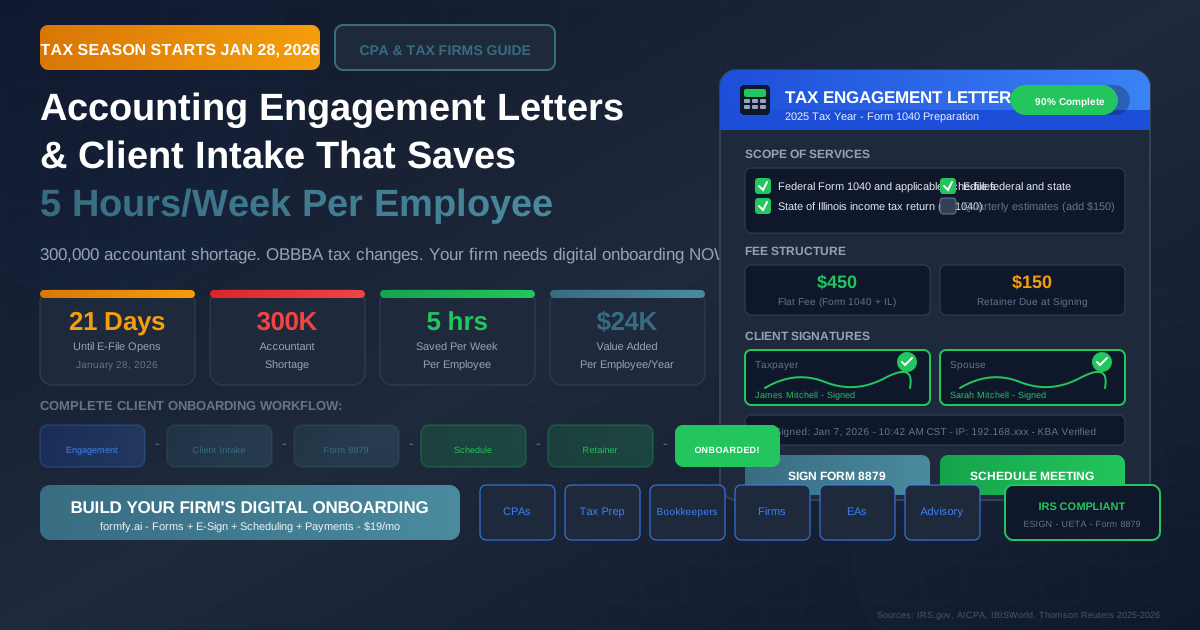
Your accounting engagement letters and client intake process will be tested like never before. Tax Season 2026 begins in 3 weeks—on January 28, the IRS starts accepting returns and your firm's busiest period officially kicks off.
But this tax season is different. A 300,000 accountant shortage has left firms scrambling to handle client loads. 75% of CPAs are set to retire within the next decade. And the One Big Beautiful Bill Act (OBBBA) has introduced sweeping tax law changes that will generate more client questions than ever before.
Meanwhile, your onboarding workflow—engagement letters, client intake forms, Form 8879 signatures, document collection—still takes days instead of minutes.
Here's what the data shows: Firms using digital onboarding save 5 hours per week per employee. At $50/hour, that's $24,000 in annual value per team member. For a 5-person firm, that's $120,000 in recovered capacity—time you could spend on billable advisory work instead of chasing signatures.
This guide covers everything accounting firms need to prepare for Tax Season 2026: engagement letter essentials, client intake checklists, Form 8879 compliance, and step-by-step digital onboarding that works.
Who this guide is for:
- CPA firms (all sizes)
- Tax preparation businesses
- Enrolled Agents (EAs)
- Bookkeepers and accounting professionals
- Tax resolution specialists
- Financial planning firms with tax services
Tax Season 2026: What Every Accounting Firm Must Know
Before diving into engagement letters and onboarding workflows, let's establish the key dates and changes your firm needs to prepare for.
Critical 2026 Tax Season Dates
| Date | Event |
|---|---|
| January 28, 2026 | IRS begins accepting e-filed returns |
| January 31, 2026 | Deadline for employers to send W-2s and 1099s |
| March 16, 2026 | S-corp (1120-S) and Partnership (1065) returns due |
| April 15, 2026 | Individual returns (1040) and C-corp returns (1120) due |
| April 15, 2026 | First quarter estimated tax payments due |
| October 15, 2026 | Extended individual returns due |
OBBBA Tax Law Changes Affecting 2025 Returns
The One Big Beautiful Bill Act introduced significant changes that will impact returns you're preparing this season:
No Tax on Tips — Service industry workers can now claim a deduction for tip income. Expect questions from restaurant workers, hospitality staff, and service professionals.
No Tax on Overtime — Overtime pay may qualify for a new deduction. This affects manufacturing, healthcare, and hourly workers who regularly work overtime.
No Tax on Car Loan Interest — A new deduction for auto loan interest. Requires clear documentation of vehicle use and loan terms.
New Senior Deduction — Additional deduction for taxpayers over 65. Your elderly clients will need guidance on eligibility.
Tax Bracket Adjustments — Standard inflation adjustments affecting millions of returns.
Trump Accounts — New retirement savings vehicle for children. Client education will be essential.
What This Means for Your Firm
These changes create both challenges and opportunities:
- More complex returns — New deductions mean more calculations and documentation
- More client questions — Taxpayers want to know how these changes affect them
- Higher advisory demand — Clients need planning help, not just return preparation
- Critical need for clear engagement letters — Scope definition is more important than ever
With more complexity comes more risk of scope creep. Your engagement letters must clearly define what's included—and what's not.
300,000 Accountants Short: Why Digital Onboarding Isn't Optional Anymore
The accounting profession is facing a staffing crisis that makes digital efficiency essential.
The Numbers Tell the Story
- 300,000 accountant shortage nationwide
- 75% of CPAs set to retire within 10 years
- 2.0% unemployment rate for accountants (Q4 2024)—the labor market is historically tight
- 60-70% of accounting and tax firms operate with no employees (solo practitioners)
- 25% IRS staff reduction by May 2025
- Nine taxpayer assistance centers closed
You can't hire your way out of this. The talent simply doesn't exist. The only path forward is doing more with fewer people—which means automation.
The Automation Opportunity
The good news: accountants are embracing technology.
- 61% of accountants view AI as an opportunity to enhance their work
- 80% of tax professionals believe AI will have a major impact within 5 years
- $6.68 billion AI in accounting market (2025), growing to $37.6 billion by 2030
- 5 hours/week saved per employee with automation
- $24,000 annual value added per employee through efficiency gains
What Top Firms Are Automating First
The biggest time savings come from automating client-facing workflows:
- Engagement letter generation and signing — Stop emailing PDFs and chasing signatures
- Client intake form collection — Gather all information before the first meeting
- Document request and tracking — Know exactly what's received and what's missing
- Form 8879 signature collection — Get authorization before filing, not after
- Appointment scheduling — Let clients book their own meetings
- Retainer/deposit collection — Collect payment at signing, not 90 days later
These aren't "nice to have" features anymore. They're survival tools for a profession facing unprecedented demand with shrinking supply.
Accounting Engagement Letters: What Every CPA Firm MUST Include in 2026
What is an engagement letter? An engagement letter is a legally binding contract between an accounting firm and client that outlines the scope of services, fees, responsibilities, and terms. It protects both parties and prevents scope creep—the #1 profitability killer for accounting firms.
AICPA standards and professional liability insurers require engagement letters for every client relationship. A properly drafted letter is your first line of defense against disputes, fee collection issues, and malpractice claims.
1. Scope of Services (Be SPECIFIC)
This is the most important section of your engagement letter. Vague scope language leads to scope creep, unpaid work, and client disputes.
Do specify:
- Exact forms being prepared (1040, 1120-S, 1065, etc.)
- Which state returns are included
- Tax years covered
- Number of K-1s expected (for business returns)
- Whether estimated payment vouchers are included
Do NOT include (unless explicitly scoped):
- Prior year amended returns
- Bookkeeping or catch-up work
- Tax planning or advisory services
- Audit representation
- Quarterly payroll filings
Example scope language:
"This engagement covers preparation of your 2025 federal Form 1040, including Schedules A, B, C, D, and E as applicable, and Illinois Form IL-1040. This engagement does not include prior year returns, amended returns, tax planning consultations, or representation before the IRS."
2. Client Responsibilities
Make clear what the client must provide and when:
- Information delivery deadline — "All information must be received by [date] to guarantee completion by the filing deadline."
- Accuracy of information — "You are responsible for the accuracy and completeness of information provided."
- Supporting documentation — "You must retain supporting documents for all items on your return."
- Disclosure requirements — "You must disclose all income sources, foreign accounts, and reportable transactions."
3. Firm Responsibilities
Define what your firm commits to:
- Professional standards — Reference AICPA Code of Professional Conduct, Treasury Circular 230, and applicable state board rules
- Record retention — Specify how long you'll retain workpapers (3 years minimum for Form 8879)
- Confidentiality — Commitment to protect client information (FTC Safeguards Rule compliance)
- Response time — Expected turnaround for questions and communications
4. Fee Structure
Be explicit about compensation:
Fixed fee engagements:
- Specify the exact fee for the defined scope
- List charges for out-of-scope items
- State when payment is due (at signing, at filing, upon delivery)
Hourly engagements:
- State billing rates by staff level
- Provide estimated range if possible
- Define billing frequency and payment terms
Retainer requirements:
- Amount required to begin work
- Whether retainer is applied to final invoice or held separately
- Refund policy if engagement is terminated
5. Limitation of Liability
Protect your firm with appropriate limitations:
- Damage caps — "Our liability is limited to fees paid for this engagement."
- Consequential damages — "We are not liable for indirect, consequential, or punitive damages."
- Claim period — "Any claim must be brought within one year of the engagement's completion."
- Notification requirement — "Client must notify firm of any claim within 30 days of discovery."
6. IRS Examination Assistance
Define what happens if the client is audited:
- What's included — Typically, responding to IRS notices related to errors in your preparation
- What's additional — Audit representation, appeals, collections assistance
- Fee structure for additional services — Hourly or flat fee for audit support
7. Electronic Filing Authorization
Include consent for e-filing:
- Client authorizes electronic filing of return
- Reference to Form 8879 requirements
- Client understands e-file signature authorization process
8. Signature Section
Capture legally binding consent:
- Client signature and date
- Spouse signature (required for joint returns)
- Firm representative signature (optional but professional)
- Space for printed names
Why Annual Renewal is Essential
Engagement letters must be renewed annually because:
- Tax laws change — OBBBA changes mean last year's scope may not fit this year's return
- Fees may need adjustment — Inflation, complexity, and market rates evolve
- AICPA requires it — Professional standards call for annual engagement confirmation
- Liability insurers expect it — Many policies require current engagement letters
The Complete Tax Client Intake Form Checklist
Once the engagement letter is signed, you need comprehensive client information. A thorough intake form prevents back-and-forth and positions you for efficient return preparation.
Personal Information
- Full legal names (both spouses for joint returns)
- Social Security Numbers (and SSN for spouse)
- Dates of birth
- Current mailing address
- Phone numbers (home, cell, work)
- Email addresses
- Preferred filing status
- Occupation and employer
Dependent Information
For each dependent:
- Full legal name
- Social Security Number
- Date of birth
- Relationship to taxpayer
- Months lived with taxpayer in 2025
- Did dependent have income?
- Is dependent claimed by another taxpayer?
Income Documents Needed
- W-2s from all employers
- 1099-NEC (nonemployee compensation)
- 1099-MISC (miscellaneous income)
- 1099-INT (interest income)
- 1099-DIV (dividend income)
- 1099-B (brokerage/stock sales)
- K-1s (partnerships, S-corps, trusts, estates)
- 1099-G (unemployment compensation)
- 1099-R (retirement distributions)
- SSA-1099 (Social Security benefits)
- 1099-K (payment card transactions)
- 1099-DA (digital assets/cryptocurrency)
- Rental income and expense records
- Self-employment income records
- Gambling/lottery winnings (W-2G)
Deduction Documents
- Form 1098 (mortgage interest)
- Property tax statements
- Charitable donation receipts
- Medical expense records
- Health insurance (Form 1095-A, B, or C)
- Student loan interest (Form 1098-E)
- Tuition payments (Form 1098-T)
- State and local taxes paid
- Educator expenses
- Business expense documentation
- Home office measurements (if applicable)
- Vehicle mileage logs (if applicable)
- Child care expenses and provider information
Life Changes Checklist
Ask about changes that affect filing:
- Marriage or divorce in 2025
- Birth or adoption of a child
- Death of a spouse or dependent
- Home purchase or sale
- Job change or loss
- Retirement or pension start
- Inheritance received
- Started a business
- Moved to a different state
- Received cryptocurrency/digital assets
Foreign Asset Disclosure
For clients with foreign connections:
- Foreign bank accounts (FBAR requirement if >$10,000)
- Foreign financial assets (Form 8938)
- Foreign income sources
- Foreign tax paid
- Foreign gifts received (>$100,000)
Prior Year Information
- Copy of last year's return
- Prior year AGI (required for e-file verification)
- IP PIN (if issued by IRS)
- Outstanding tax liabilities
- Open audit or collection issues
Form 8879 E-Signature Requirements: What CPAs Must Know
What is Form 8879? Form 8879, IRS e-file Signature Authorization, is the declaration document taxpayers sign to authorize electronic filing of their tax return. EROs (Electronic Return Originators) must obtain this signed form BEFORE transmitting the return to the IRS.
E-Signature is Now Permanently Allowed
The IRS has permanently extended electronic signature acceptance for:
- Form 8878 (IRS e-file Signature Authorization for Form 4868 or Form 2350)
- Form 8879 (IRS e-file Signature Authorization)
- Form 8453 series (various e-file signature documents)
This is no longer temporary pandemic relief—it's permanent policy per IRS guidance.
Requirements for Remote E-Signatures
When clients sign Form 8879 remotely (not in your physical presence), you must implement Knowledge-Based Authentication (KBA) per IRS Publication 1345 and NIST SP 800-63 guidelines.
Your e-signature system must capture:
- Digital image of the signature
- Date and time of signing
- IP address of the signer
- Identity verification meeting NIST IAL2 standards
What Qualifies as KBA
Knowledge-Based Authentication requires questions that only the taxpayer would know:
- Personal history questions (previous addresses, employers)
- Financial questions (loan amounts, account numbers)
- Identity verification questions from authoritative sources
Note: Credit bureau questions are allowed but NOT required. SMS verification to a registered phone number is acceptable under NIST guidelines for IAL2.
Multi-Year Business Relationship Exception
KBA is NOT required if:
- The taxpayer has signed an e-file authorization with your firm in a prior year, AND
- The taxpayer is signing in your physical presence
For remote signing, KBA is always required regardless of relationship history.
Record Retention Requirements
You must retain signed Form 8879 for 3 years from:
- The return due date, OR
- The date the IRS received the return
Whichever is later. Electronic retention is permitted under Rev. Proc. 97-22.
ERO Responsibilities
As an Electronic Return Originator, you must:
- Provide Form 8879 to the taxpayer with completed return information
- NOT transmit until the signed form is received
- Record the 20-digit Submission ID on the signed form
- Provide a copy to the taxpayer upon request
- Retain the form for the required period
How to Build a Complete Tax Client Onboarding System with Formfy
Here's a step-by-step guide to creating a digital onboarding workflow that takes clients from initial contact to ready-for-filing status.
Step 1: Create Your Engagement Letter (15 minutes)
- Log into Formfy and use the AI wizard: "Create a tax preparation engagement letter"
- Add your firm's scope of services with specific forms
- Include your fee schedule and payment terms
- Add limitation of liability language
- Insert signature fields for client(s) and spouse
- Add a firm signature field (optional)
- Preview and test the form
Step 2: Build Client Intake Form (15 minutes)
- Create a new form with personal information section
- Add dependent information (repeatable fields)
- Include income document checklist
- Add deduction categories with checkboxes
- Build the life changes questionnaire
- Add document upload fields for key items
Step 3: Create Document Request List (10 minutes)
- Create a checklist form with all required documents
- Add file upload fields for each category (W-2s, 1099s, K-1s, etc.)
- Include status tracking (received, pending, not applicable)
- Add notes field for client questions
Step 4: Add Form 8879 Signature Collection (5 minutes)
- Upload your Form 8879 template
- Add signature field for taxpayer
- Add signature field for spouse (conditional for joint returns)
- Enable KBA verification for remote signing
- Timestamp and IP logging are automatic in Formfy
Step 5: Set Up Consultation Scheduling (10 minutes)
- Configure your available appointment times
- Create appointment types:
- Initial tax consultation (60 min)
- Document review meeting (30 min)
- Tax planning session (60 min)
- Set buffer times between appointments
- Optional: Require deposit at booking to reduce no-shows
Step 6: Configure Payment Collection (5 minutes)
- Connect your Stripe and/or PayPal account
- Set retainer amount (e.g., 50% of estimated fee)
- Configure payment timing options:
- Upfront at engagement signing
- At document submission
- Split between signing and filing
- Add invoice/receipt automation
Step 7: Create Automated Workflow (10 minutes)
Link all steps into one seamless client experience:
- Step 1: Client clicks your onboarding link
- Step 2: Signs engagement letter
- Step 3: Completes client intake form
- Step 4: Uploads documents
- Step 5: Signs Form 8879 (when return is ready)
- Step 6: Schedules consultation appointment
- Step 7: Pays retainer
All steps are trackable from your Formfy dashboard.
Step 8: Deploy (5 minutes)
Make your onboarding accessible everywhere:
- Email existing clients the onboarding link
- Add to your firm website as "New Client" button
- Create QR code for your office lobby
- Set up automated reminders for incomplete onboarding
Total setup time: ~75 minutes
Client onboarding time: ~15-20 minutes (vs. days with manual processes)
Case Study: How a 10-Person CPA Firm Reduced Onboarding Time by 60%
Note: This case study is illustrative of results accounting firms can achieve with digital onboarding.
The Challenge
Anderson Tax & Advisory, a 10-person CPA firm in the Chicago suburbs, was drowning in administrative work before tax season:
- 800+ individual returns and 200+ business returns annually
- Previous onboarding process took 7-10 days per client
- Staff spent hours emailing engagement letters, chasing signatures, and following up on documents
- 15% of clients still hadn't signed engagement letters by mid-March
- Form 8879 collection happened after returns were ready, causing filing delays
The Solution: Formfy Implementation
The firm implemented a complete digital onboarding workflow:
- Digital engagement letter with e-signature collection
- Client intake form with document upload capability
- Form 8879 signature collection with KBA verification
- Integrated appointment scheduling for client meetings
- Retainer collection at engagement signing
The Results (Tax Season 2026)
| Metric | Before | After | Change |
|---|---|---|---|
| Average onboarding time | 7-10 days | 2-3 days | 65% reduction |
| Clients onboarded before Feb 15 | 71% | 89% | +18 points |
| Form 8879 signed before filing | 85% | 99% | +14 points |
| Staff admin hours/week | 25 hours | 13 hours | -12 hours |
| Client satisfaction score | 4.2/5 | 4.7/5 | +0.5 points |
Key Insight from the Managing Partner
"We used to spend January chasing signatures. Now clients complete everything online before their first appointment. We actually have TIME to do tax planning instead of paperwork. The retainer requirement at signing also improved our cash flow significantly—no more waiting 90 days to get paid."
The firm estimated the recovered staff time was worth approximately $30,000 in the first tax season alone.
Engagement Letters for Every Accounting Service
Different services require different engagement letter provisions. Here's what to include for each service type:
Individual Tax Preparation (Form 1040)
Scope specifics:
- Federal Form 1040 and specified schedules
- State returns by name (IL-1040, NY IT-201, etc.)
- Estimated payment calculations (include or exclude)
- Amended returns (typically excluded unless specified)
Special considerations:
- Self-employment income (Schedule C complexity)
- Rental properties (number of properties)
- Investment income (cost basis research)
Business Tax Preparation (1120-S, 1065, 1120)
Scope specifics:
- Entity type and return form
- Number of K-1s to be prepared
- State filing requirements (nexus states)
- Quarterly estimated payments
Special considerations:
- Basis calculations and tracking
- Reasonable compensation analysis (S-corps)
- Partnership allocation schedules
Bookkeeping Services
Scope specifics:
- Monthly, quarterly, or annual basis
- Bank reconciliation (how many accounts)
- Credit card reconciliation
- Journal entry preparation
What to clarify:
- Payroll processing (included or separate)
- Financial statement preparation
- Year-end adjustments
- 1099 preparation
Advisory/Consulting Services
Scope specifics:
- Hourly vs. project-based billing
- Deliverables defined (written report, analysis, recommendations)
- Number of meetings included
Disclaimers:
- Tax planning vs. tax advice distinction
- No guarantee of outcomes
- Client implementation responsibility
Audit/Review/Compilation
Scope specifics:
- Engagement type (audit, review, compilation)
- SSARS or GAAS standards reference
- Financial statement periods covered
Required elements:
- Management representation letter requirement
- Report distribution limitations
- Independence statements
Payroll Services
Scope specifics:
- Pay frequency
- Number of employees
- States for withholding
- Tax deposit frequency
Services to clarify:
- W-2 and 1099 preparation (typically annual fee)
- Year-end reconciliation
- State unemployment filings
- Workers' compensation reporting
Legal Protection: What Every Accounting Engagement Letter Must Address
Engagement letters are your primary legal protection. Include these elements:
Limitation of Liability Clauses
- Damage cap: "Firm's liability shall not exceed fees paid for this engagement"
- Exclusion of consequential damages: "In no event shall either party be liable for indirect, incidental, consequential, or punitive damages"
- Prompt notification: "Client must notify Firm of any claim within 30 days of discovery"
Statute of Limitations
- One-year claim period — Standard for professional services
- Start date clarity — Begins at signature date or service completion
- Explicit statement — "Any action relating to this engagement must be commenced within one year"
Professional Standards Reference
Demonstrate compliance by referencing:
- AICPA Code of Professional Conduct
- Treasury Circular 230 (for tax practitioners)
- State Board of Accountancy rules
- IRS Practitioner Regulations
Confidentiality and Data Security
With FTC Safeguards Rule requirements:
- Client data protection commitment
- Breach notification procedures
- Third-party disclosure limitations (Formfy is SOC 2 Type II compliant)
- Record retention and destruction policies
Indemnification Provisions
- Client indemnifies firm for false or incomplete information
- Client responsible for tax positions taken
- Penalty responsibility (firm only liable for preparer penalties caused by firm error)
Dispute Resolution
Consider including:
- Mediation requirement before litigation
- Arbitration clause (binding vs. non-binding)
- Venue specification (your state and county)
- Attorney fees (prevailing party)
E-Signature Legal Validity
Your engagement letters are legally binding when signed electronically under:
- ESIGN Act (federal law, all 50 states)
- UETA (adopted by 49 states)
Requirements: clear intent to sign, identifiable signer, secure record retention. Formfy captures all required elements including timestamp, IP address, and provides audit certificates.
Frequently Asked Questions: Accounting Engagement Letters & Client Intake
What is an accounting engagement letter?
An accounting engagement letter is a legally binding contract between an accounting firm and client that outlines the scope of services, fees, responsibilities, and terms. It protects both parties, defines what is and isn't included in the engagement, and helps prevent scope creep. AICPA and professional liability insurers require engagement letters for every client relationship.
Why do CPAs need engagement letters every year?
Annual renewal is required because tax laws change every year (like the 2025 OBBBA changes), fees may need adjustment, the scope of services may have changed, and AICPA professional standards require fresh engagement confirmation. A signed engagement letter protects against disputes and clarifies expectations for both parties.
What should be included in a tax engagement letter?
A comprehensive tax engagement letter should include: (1) Specific scope of services with exact forms, (2) Client responsibilities for providing information, (3) Firm responsibilities and professional standards, (4) Fee structure and payment terms, (5) Limitation of liability provisions, (6) IRS examination assistance scope, (7) E-file authorization, and (8) Signature sections for all parties.
Are digital engagement letters legally binding?
Yes. Digital engagement letters with electronic signatures are legally binding under the ESIGN Act (federal law) and UETA (adopted by 49 states). The key requirements are clear intent to sign, identifiable signer, and secure record retention. Formfy captures timestamp, IP address, and provides a complete audit certificate meeting all legal requirements.
What is Form 8879 and when is it required?
Form 8879, IRS e-file Signature Authorization, is the declaration document taxpayers sign to authorize electronic filing of their tax return. It's required when using the Practitioner PIN method. The ERO must receive the signed Form 8879 BEFORE transmitting the return to the IRS.
Can clients e-sign Form 8879 remotely?
Yes. The IRS permanently extended e-signature for Form 8879. For remote e-signatures, Knowledge-Based Authentication (KBA) is required per IRS Publication 1345 and NIST SP 800-63. The e-signature must capture a digital image, date/time, IP address, and identity verification. Formfy's e-signature solution meets all IRS requirements.
What is Knowledge-Based Authentication (KBA)?
KBA is an identity verification method required by the IRS for remote e-signatures on Form 8879. Questions must use information only the taxpayer and authoritative sources would know. SMS verification to a registered phone number is acceptable under NIST guidelines. KBA is NOT required if the taxpayer signs in your physical presence.
How long must I retain signed engagement letters?
For Form 8879, the IRS requires retention for 3 years from the return due date or IRS received date (whichever is later). For engagement letters, best practice is 7+ years to match your firm's general record retention policy and state statute of limitations for professional liability claims.
What's the difference between an engagement letter and a contract?
An engagement letter IS a contract—it's a legally binding agreement between your firm and the client. The term "engagement letter" is simply the accounting profession's terminology for a service contract. It creates enforceable obligations for both parties.
Can I use the same engagement letter for all clients?
You can use a standardized template, but you should customize the scope section for each client's specific situation. A business tax client needs different scope language than an individual. Using the same boilerplate without customization can lead to scope disputes.
How do I handle scope creep with existing clients?
When clients request work outside the engagement scope: (1) Acknowledge the request, (2) Explain it's outside the current engagement, (3) Provide a fee quote for the additional work, (4) Get written approval before proceeding. Document everything.
What if a client refuses to sign the engagement letter?
Do not begin work without a signed engagement letter. Explain that it protects both parties and is required by professional standards. If they still refuse, consider whether you want them as a client—unsigned engagements are the leading cause of fee disputes.
Should engagement letters include fee quotes?
Yes, always. Whether fixed fee or hourly with an estimate, clients need to know expected costs. Vague fee language leads to bill disputes. "Fees will be billed at our standard rates" is insufficient—specify rates or provide ranges.
How do I get both spouses to sign for joint returns?
Digital tools like Formfy support multiple signers. Each spouse receives a link to sign on their own device. The system tracks both signatures with full audit trails, ensuring both parties have authorized the engagement and e-filing.
What's the best way to collect W-2s and 1099s from clients?
Use a digital intake form with file upload fields for each document type. This creates organization, provides confirmation of receipt, and eliminates "I already sent that" disputes. Formfy forms can accept PDF, image, and other file uploads.
Can Formfy handle Form 8879 signatures?
Yes. Formfy supports IRS-compliant e-signatures including KBA verification, timestamp capture, IP address logging, and audit trail generation. You can upload your Form 8879 template and add signature fields for taxpayer(s).
How much does accounting e-signature software cost?
Dedicated e-signature tools like DocuSign cost $25-50+/month with per-signature fees. Practice management platforms can cost $40-100+/month. Formfy offers e-signatures plus forms, scheduling, and payment collection for $19/month with no per-signature fees—replacing multiple tools and saving firms $43+/month.
What compliance standards should my firm meet?
Key standards include: IRS Publication 4557 (data security), FTC Safeguards Rule (customer financial information), SOC 2 Type II (service organization controls), and state-specific requirements. Formfy is SOC 2 Type II compliant.
How do I transition existing clients to digital onboarding?
Send a clear email explaining the new process benefits (faster, easier, more secure). Provide a direct link to your onboarding form. Set a deadline for completion. Follow up with phone calls for clients who haven't completed. Most clients appreciate the convenience once they try it.
What if clients aren't tech-savvy?
Formfy forms work on any device with a web browser—no app downloads required. The interface is designed for simplicity. For truly technology-averse clients, you can share your screen during a phone call and walk them through the process, or have them complete forms in your office using a tablet.
Tax Season 2026 Starts in 3 Weeks—Is Your Firm Ready?
The clock is ticking. January 28, 2026—just 21 days away—marks the start of another tax season.
But this season, your firm faces unprecedented challenges:
- 300,000 accountant shortage means everyone is stretched thin
- OBBBA tax law changes mean more complex returns and more client questions
- IRS staffing cuts mean longer resolution times when issues arise
The firms that will thrive aren't working harder—they're working smarter.
The math is clear:
- 5 hours saved per week × $50/hour = $250/week per employee
- $250 × 52 weeks = $13,000/year per employee
- 5-person firm = $65,000 in recovered capacity annually
That's time you could spend on billable advisory work, client development, or simply going home at a reasonable hour during busy season.
Ready to Transform Your Firm's Onboarding?
You can build your complete digital onboarding system in about 75 minutes with Formfy:
- Engagement letters with legally binding e-signatures
- Client intake forms with document upload capability
- Form 8879 collection with IRS-compliant KBA verification
- Appointment scheduling to eliminate back-and-forth emails
- Retainer collection to improve cash flow
All for $19/month—less than one hour of billable time.
That's engagement letters + intake forms + Form 8879 + scheduling + payments in ONE platform. Replace tools that would cost $62+/month separately while actually getting better functionality.
Tax Season 2026 is coming whether you're ready or not. The question is: will you spend January chasing signatures, or will you spend it serving clients?
Disclaimer: This article provides general information about accounting engagement letters and client onboarding practices. It is not legal, tax, or professional advice. Engagement letter requirements, IRS regulations, and state laws vary. Consult with a qualified attorney and review AICPA standards to ensure your engagement letters comply with professional requirements and adequately protect your firm.
Sources: IRS.gov (Tax Season dates, Form 8879 requirements, e-signature guidance), AICPA (engagement letter standards), IBISWorld (market research), Thomson Reuters (industry statistics), NIST SP 800-63 (identity verification standards)
Related Articles
Formfy Team
Product Team
Related Articles

How to Choose Digital Waiver Software for Your Fitness Studio: A Feature Buying Guide
Evaluate digital waiver software for your gym or studio. Feature checklist covering risk language, screening, guardian flows, upload conversion, and signatures.
Acupuncture and Holistic Health Intake Forms: Build Complete Consent and Screening Workflows for Wellness Practices
Build complete acupuncture intake forms with TCM diagnostic screening, medication checks, contraindication logic, multi-modality consent, and e-signatures.
How to Digitize Daycare Registration Forms (Enrollment, Consent & Pickup Auth)
Step-by-step guide to digitizing daycare enrollment forms. Covers registration, guardian consent, medical history, allergy disclosures, and pickup authorization — all in one digital packet.