
E-Scooter Waiver Requirements 2025: 560% Injury Surge
E-scooter injuries surged 560%. New 2025 waiver requirements for e-bike and scooter rental businesses to avoid $500K+ claims.
Formfy Team
Product Team
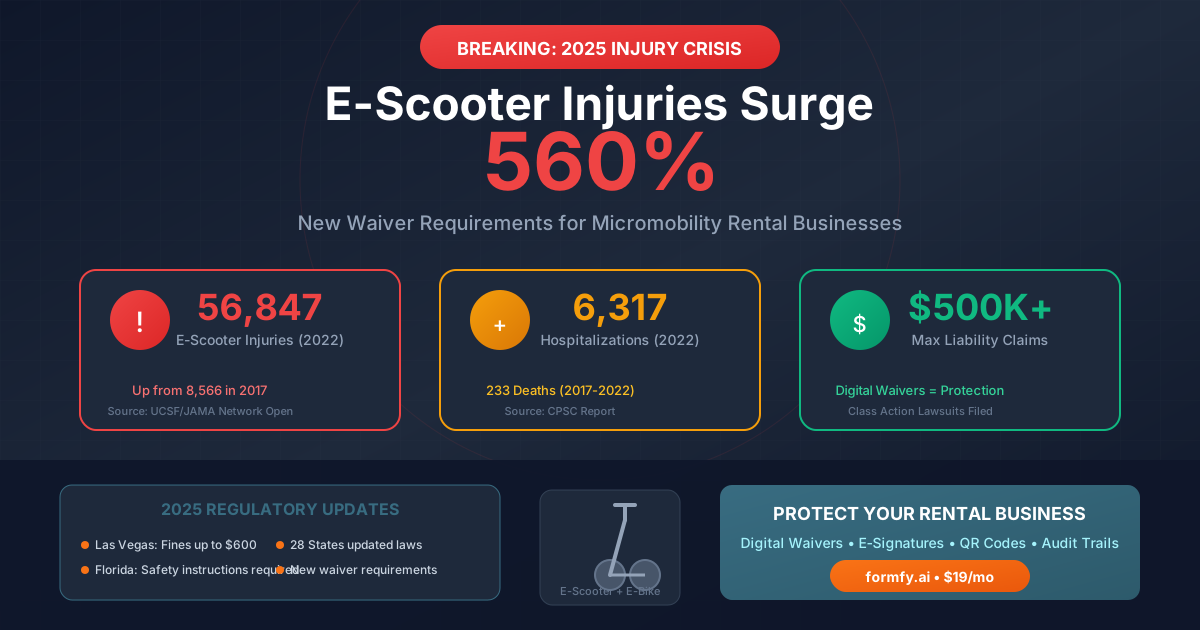
BREAKING: E-scooter waiver requirements are intensifying as new research reveals a 560% surge in injuries since 2017. A landmark UCSF study published in JAMA Network Open documents that e-scooter injuries exploded from 8,566 in 2017 to 56,847 in 2022—while e-bike injuries doubled every year for five consecutive years.
The crisis extends beyond injuries: the Consumer Product Safety Commission (CPSC) reports 233 deaths from micromobility devices between 2017-2022. With class action lawsuits now targeting companies like Bird and Lime, and liability settlements exceeding $500,000 in severe cases, micromobility rental businesses face existential risks without proper digital waiver systems.
New 2025 regulations in Clark County (Las Vegas), Florida, Long Beach, and Seattle are mandating stricter safety requirements—and exposing businesses with inadequate documentation to unprecedented liability. Here's what e-scooter and e-bike rental operators need to know.
The Numbers: E-Scooter & E-Bike Injury Statistics That Should Alarm Every Rental Operator
The UCSF research team analyzed national injury data from 2017-2022, revealing a micromobility safety crisis that demands immediate attention from rental operators.
The Five-Year Explosion
| Year | E-Scooter Injuries | E-Bike Injuries | Hospitalizations |
|---|---|---|---|
| 2017 | 8,566 | ~5,000 | ~1,500 |
| 2018 | 14,651 | ~10,000 | ~3,000 |
| 2019 | 20,000+ | ~15,000 | ~4,500 |
| 2020 | 25,000 | ~18,000 | ~5,000 |
| 2021 | 40,000+ | ~19,000 | ~6,000 |
| 2022 | 56,847 | 23,493 | 9,439 |
Sources: UCSF/JAMA Network Open, CPSC
The CPSC's comprehensive report reveals even more alarming figures:
- Total micromobility ER visits (2017-2022): 360,800
- E-scooter injuries alone: 169,300 (46.92% of total)
- E-scooter injuries rose 22% in 2022 from 2021
- 46% of ALL e-bike injuries from the entire 2017-2022 period occurred in 2022 alone
Who's Getting Hurt
The injury demographics reveal critical patterns for waiver requirements:
- Children 14 and under: 36% of injuries—double their 18% share of the population
- Alcohol involvement in powered scooter injuries: 9% (highest among all mobility modes)
- 25% of hospitalized patients were using substances (alcohol, opioids, marijuana)
- Helmet usage noticeably lower among e-vehicle users than traditional cyclists
Common Injury Types
Understanding injury patterns helps inform waiver language:
- Head injuries / Traumatic brain injury (TBI): Most severe, often permanent
- Broken bones: Arms, wrists, legs, ribs—common in falls
- Internal injuries: More common in e-scooter vs conventional scooter accidents
- Spinal cord injuries: Life-altering consequences
- Facial trauma and dental injuries: Frequent in forward falls
The UCSF researchers concluded: "This increase in accidents underscores an urgent need for added safety measures." For rental businesses, that starts with comprehensive digital waivers.
Why Traditional Waivers Aren't Enough: The Legal Landscape in 2025
The surge in e-scooter injuries has triggered a wave of litigation that's redefining liability expectations for rental businesses.
The Class Action Reality
Class action lawsuits have been filed against Bird and Lime in California courts, with plaintiffs alleging:
- "Gross negligence" in equipment maintenance
- "Public nuisance" from improper scooter deployment
- Claims that companies "dumped" scooters without adequate safety warnings
- Failure to enforce age restrictions and safety protocols
These lawsuits challenge the effectiveness of click-through waivers when companies fail to meet basic safety obligations.
What Waivers CAN Protect Against
A properly drafted e-scooter waiver can protect your business from:
- Ordinary negligence claims: Standard accidents during proper use
- Assumption of risk: Rider acknowledged inherent dangers
- Known hazards: Road conditions, traffic, weather
- Rider error: Falls, collisions from rider mistakes
What Waivers CANNOT Protect Against
Waivers have limitations—understanding them is critical:
- Gross negligence or intentional misconduct: Waivers don't cover reckless business behavior
- Product defects: Brake failure, throttle lock, handlebar issues
- Failure to follow basic safety protocols: Inadequate maintenance, broken equipment
- State-specific restrictions: Virginia, Montana, Louisiana have stricter waiver limitations
The Settlement Reality
When injuries occur without adequate waiver protection:
- Average major injury settlement: $50,000+
- Severe cases (TBI, spinal): $200,000-$500,000+
- Without proper waivers: Potentially unlimited exposure
- Florida documented settlements: Frequently exceed $50,000 for major injuries
The Digital Advantage
Digital waivers provide legal benefits paper cannot match:
- Timestamped signatures prove exactly when consent was given
- IP address logging creates geographic verification
- Audit trails demonstrate compliance efforts
- Instant retrieval during litigation—no searching file cabinets
- Device information adds another verification layer
For comprehensive guidance on e-signature legality, see our guide: Are Electronic Signatures Legally Binding?
2025 Regulatory Updates: What Micromobility Businesses Must Know
As of mid-2024, 28 states and Washington, D.C. have updated e-scooter laws. 2025 brings even more significant changes:
Clark County (Las Vegas) - May 2025
The new regulations mandate:
- Equipment requirements: Bell/horn, functional brakes, front/rear lights
- Banned behaviors: Reckless riding, stunts, unsafe speeds
- Fines up to $600 for violations
- Parental responsibility: Parents/guardians financially responsible for minors' violations
- Prohibited zones: E-scooters banned on Las Vegas Strip resort corridor
- Speed limit: 15 mph in county parks and trails
Florida - 2025 New Law
Florida's updated legislation requires:
- Rental companies MUST provide safety instructions
- Regular maintenance requirements codified into law
- Minimum rider age: 16 in most cities
- Parental waiver required for minors in select areas
- Breaking rules can reduce settlement payouts in injury cases
Long Beach, California - May 2025
The E-Scooter Beach Bike Path Pilot establishes:
- Speed limit: 15 mph (5 mph near pedestrians)
- Parking: Designated corrals only
- Data collection for long-term policy decisions
Seattle - 2025
Free-Floating Shared Micromobility Permit Requirements include:
- Geofencing technology mandatory for no-parking zones
- Vendors must relocate non-compliant devices
- Real-time compliance monitoring
Portland, Oregon - 2024
New parking requirements mandate:
- Must lock to public bike rack
- City signpost acceptable if bike racks unavailable
- Penalties for improper parking
What This Means for Rental Businesses
To maintain compliance and reduce liability:
- Update waivers to reflect local regulations
- Include specific prohibited behaviors in waiver language
- Add equipment acknowledgment sections confirming safety features work
- Document safety instruction delivery with timestamps
- Implement age verification that meets or exceeds local requirements
Essential Elements of an E-Scooter/E-Bike Rental Waiver
A comprehensive micromobility waiver must address the unique risks of electric-powered vehicles. Here's what to include:
1. Rider Information & Verification
Required fields:
- Full legal name
- Date of birth (critical for age verification)
- Government ID number or last 4 digits
- Contact information (phone, email)
- Emergency contact
2. Equipment Acknowledgment
Document that the rider:
- Received specific vehicle ID/number
- Inspected equipment before use
- Confirmed safety features work (brakes, lights, bell)
- Noted battery charge level at checkout
3. Safety Rules Acknowledgment
Rider must accept:
- Helmet recommendation/requirement disclosure
- Local speed limits (typically 15-20 mph)
- Prohibited areas (sidewalks, specific zones)
- Traffic law compliance requirement
- Proper parking procedures
- No riding under influence of alcohol/drugs
- No passengers (single rider only)
4. Age Verification & Parental Consent
Include provisions for:
- Confirmation of minimum age (16-18 depending on location)
- Parental/guardian signature for minors where permitted
- Valid driver's license/ID verification statement
State-by-state age requirements vary:
| State | Minimum Age | Notes |
|---|---|---|
| Colorado | 12+ | Helmet required under 18 |
| California | 16+ | Local laws may vary |
| Florida | 16+ | State minimum |
| New York | 16+ | NYC has additional rules |
| Arizona | 16+ | Varies by city |
| Alabama | 19+ | Or 18+ with parental consent |
| Rental Companies | 18+ | Bird, Lime, Spin policy |
5. Assumption of Risk Clause
Rider acknowledges:
- Inherent dangers of electric-powered vehicles
- Understanding that falls, collisions, injuries can occur
- Recognition of road hazards, traffic, weather conditions
- Acceptance of risks from other riders, vehicles, pedestrians
- Balance and coordination requirements
- Battery and electrical system risks
6. Liability Release
Core protection elements:
- Release from ordinary negligence claims
- Hold harmless agreement
- Indemnification for rider's actions toward third parties
- Clear language that does NOT attempt to waive gross negligence (unenforceable)
7. Medical Authorization
Include provisions for:
- Emergency medical treatment authorization
- Health conditions disclosure that may affect riding
- Insurance information (optional but helpful)
8. Local Regulation Compliance
Rider confirms understanding of:
- City-specific rules acknowledgment
- Geofencing zone awareness
- Parking requirement understanding
- Speed limit restrictions
9. Photo/Video Release (Optional)
Consent for:
- Security footage use
- Marketing purposes if applicable
- Incident documentation
10. Digital Signature Requirements
For legal validity:
- E-signature with timestamp
- IP address capture
- Device information logging
- Clear "I Agree" action
- PDF audit trail generation
Legal Disclaimer: This information is for educational purposes only. Consult a licensed attorney in your jurisdiction for specific waiver requirements.
Digital vs Paper Waivers: Why E-Scooter Businesses Are Going Digital
The speed and scale of e-scooter rentals make digital waivers not just preferable—but essential.
| Factor | Paper Waivers | Digital Waivers |
|---|---|---|
| Completion Speed | 3-5 minutes | 30-60 seconds |
| ID Verification | Manual check | Integrated verification |
| Storage | Physical filing | Cloud-based, searchable |
| Retrieval | Hours to locate | Instant search |
| Legal Strength | Can be challenged | Timestamp + IP proof |
| Scalability | Staff limited | Unlimited concurrent |
| Multi-Location | Separate systems | Centralized management |
| Updates | Reprint required | Instant across fleet |
| Cost | Paper, storage, labor | $19/month flat |
The Speed Factor
E-scooter rentals are impulse decisions:
- Tourist sees scooter, wants to ride NOW
- Long waiver process = lost customers
- QR code → complete in 60 seconds → ride
The Volume Factor
Busy rental locations handle massive throughput:
- Tourist areas: 100+ rentals/day
- Paper waivers create bottlenecks
- Digital waivers scale infinitely
The Legal Factor
The Bird and Lime lawsuits highlight why documentation matters:
- Digital audit trails are stronger in court
- Timestamps prove consent timing
- IP addresses verify location
- Instant retrieval during legal discovery
QR Code Strategy for E-Scooter Fleets
QR codes transform e-scooter waiver collection from friction point to seamless experience.
Physical QR Placement
Deploy QR codes strategically:
- On scooter handlebar: Most visible location
- On kickstand/frame: Secondary location
- At docking stations: Catch users before unlocking
- On charging stations: Reach users during charging
- In rental kiosks: Traditional rental points
The Workflow
- Customer scans QR code on scooter
- Opens waiver form on mobile device (no app required)
- Completes form in 60-90 seconds
- E-signs with finger/stylus
- Receives confirmation + unlock code
- Scooter releases automatically (if integrated)
Benefits
- No app download required: Works on any smartphone browser
- Captures data before ride starts: Waiver precedes rental
- Reduces staff touchpoints: Self-service model
- Creates instant digital record: Stored immediately in cloud
- Works offline-friendly: Form caches, submits when connected
Integration Options
Connect your waiver system to operations:
- Scooter unlock systems via API
- Fleet management software sync
- Automated reminders for repeat customers
- Payment processing integration
Formfy includes QR code generation and sharing options built into the platform.
Building Your Micromobility Waiver with Formfy
Here's how to create a compliant e-scooter waiver quickly:
Step 1: Choose Your Approach
Three options:
- AI Wizard: Describe "e-scooter rental waiver" and generate instantly
- Visual Canvas Builder: Drag-and-drop custom fields with 15+ field types
- PDF Conversion: Upload existing waiver, convert to digital
Step 2: Add Critical Fields
Include all essential elements:
- Personal information section
- Age verification checkbox
- Equipment acknowledgment
- Safety rules acceptance
- Assumption of risk (use provided language)
- Liability release
- E-signature field with timestamp
Step 3: Configure Settings
Set up for legal protection:
- Enable IP address logging
- Turn on timestamp capture
- Set up confirmation emails
- Create PDF audit trail downloads
Step 4: Generate QR Codes
Create deployment-ready codes:
- Unique codes per location/scooter if needed
- Print durable weather-resistant labels
- Test scanning in outdoor conditions
Step 5: Test and Launch
Before going live:
- Complete test waivers internally
- Verify audit trail generation
- Train staff on system
- Go live with soft launch
Why Formfy for Micromobility
Formfy offers advantages for e-scooter businesses:
- QR code generation included in every plan
- Mobile-optimized forms critical for on-street use
- Audit trail PDFs for legal protection
- $19/month vs $100+ for specialized software
- No per-waiver fees: Unlimited submissions
Protecting Against Common E-Scooter Liability Claims
Understanding common claims helps you build stronger waivers.
Claim Type 1: "I Didn't Know It Was Dangerous"
Your defense:
- Signed assumption of risk clause
- Digital proof with timestamp showing acknowledgment before ride
- Specific language about inherent dangers
Claim Type 2: "The Scooter Was Defective"
Your defense:
- Equipment inspection acknowledgment in waiver
- Pre-ride checklist completion documented
- Note: Actual defects may still create liability—waivers don't cover product defects
Claim Type 3: "I Wasn't Told the Rules"
Your defense:
- Safety rules section in waiver with checkboxes
- Digital proof showing specific clauses they accepted
- Timestamp proving acknowledgment before ride
Claim Type 4: "I'm Underage and Shouldn't Have Been Allowed"
Your defense:
- Age verification checkbox with date of birth
- ID acknowledgment in waiver
- Parental consent section for jurisdictions allowing minor rentals
Claim Type 5: "The Rental Company Was Negligent"
Your defense:
- Documented maintenance protocols
- Regular safety inspection records
- Note: Waivers don't protect against proven gross negligence
Documentation Best Practices
Maximize your legal protection:
- Keep waiver records for statute of limitations period (2-3 years typically)
- Export and backup regularly
- Maintain equipment maintenance logs separate from waivers
- Document safety instruction delivery with timestamps
- Photograph/video fleet condition regularly
Case Study: What a Modern E-Scooter Waiver Flow Looks Like
Scenario: Coastal City E-Scooter Rentals
Before Digital:
- Paper waivers at kiosk
- 5-minute completion time
- Staff manually filed forms
- Waiver retrieval took hours
- Lost forms = lost protection
After Implementing Formfy:
- QR codes on each scooter
- 60-second mobile completion
- Automatic cloud storage
- Instant search and retrieval
- Complete audit trail for every rental
Results:
- Rental time reduced 80%
- Customer complaints down 45%
- Zero waiver retrieval delays during incident investigation
- Full protection when rider filed injury claim
- Staff time redirected to customer service
The Insurance Angle: What Rental Companies Provide
Understanding existing coverage helps position your additional protection:
Bird Coverage
- Does NOT provide rider coverage
- Users are personally responsible for injuries
- General liability covers company operations only
Lime Coverage
- Offers rider insurance in select markets
- Includes accident coverage
- Liability up to $10,000 in California
- Coverage varies by location
What This Means for Independent Operators
- Don't rely on manufacturer coverage
- Obtain commercial general liability insurance
- Consider specific micromobility coverage
- Use waivers as additional protection layer
- Document everything for insurance claims
Frequently Asked Questions
What should be included in an e-scooter rental waiver?
A comprehensive e-scooter rental waiver should include: rider identification and age verification, equipment acknowledgment, safety rules acceptance (speed limits, prohibited areas, no riding under influence), assumption of risk clause acknowledging inherent dangers, liability release for ordinary negligence, emergency medical authorization, local regulation compliance acknowledgment, and a legally-binding e-signature with timestamp and IP logging.
Are e-scooter waivers legally binding?
Yes, e-scooter waivers are legally binding when properly drafted under the ESIGN Act and UETA. They must include clear consent, e-signature capture, timestamp, and audit trail. However, waivers cannot protect against gross negligence, product defects, or intentional misconduct. Some states like Virginia, Montana, and Louisiana have additional restrictions on waiver enforceability.
Can you sue an e-scooter rental company like Bird or Lime?
Yes, you can sue e-scooter rental companies despite their waivers. While rental agreements include liability waivers, these may not be enforceable in cases of gross negligence, product defects, or intentional misconduct. Class action lawsuits have been filed against Bird and Lime alleging negligence in equipment maintenance and safety protocols.
What are the 2025 e-scooter regulations?
In 2025, major regulatory updates include: Clark County (Las Vegas) mandating equipment requirements and fines up to $600; Florida requiring rental companies to provide safety instructions; Long Beach launching e-scooter beach path pilots with 15 mph limits; and Seattle implementing geofencing requirements. As of mid-2024, 28 states and Washington D.C. have updated e-scooter laws.
Do e-scooter rental companies have insurance?
Coverage varies by company. Lime offers rider insurance including accident coverage and liability up to $10,000 in California. Bird does not provide rider coverage—users are personally responsible. For fleet operators, commercial general liability insurance and specific micromobility coverage are recommended alongside comprehensive waivers.
How many e-scooter injuries occur each year?
According to UCSF research, e-scooter injuries surged from 8,566 in 2017 to 56,847 in 2022—a 560% increase. The CPSC reported 169,300 e-scooter-related ER visits from 2017-2022, with 233 deaths during that period. In 2022 alone, there were approximately 56,847 e-scooter ER visits and 6,317 hospitalizations.
What is the minimum age to rent an e-scooter?
Rental company policies (Bird, Lime, Spin) require users to be 18+ with valid ID, which is stricter than most state laws. State minimum ages vary: 12+ in Colorado (helmet required under 18), 16+ in California, Florida, New York, Arizona, and 19+ in Alabama. Rental businesses should verify local regulations and implement the stricter of state law or company policy.
How do I create a digital waiver for my e-scooter rental business?
Use an all-in-one platform like Formfy to create digital waivers: 1) Use the AI wizard to generate a waiver template, 2) Customize with your specific terms and local regulations, 3) Add e-signature fields with timestamp/IP capture, 4) Generate QR codes for your fleet, 5) Place QR codes on scooters/at rental points, 6) Set up cloud storage and audit trail downloads.
What happens if someone gets hurt on my rental e-scooter?
If a rider is injured, your liability depends on the cause and your waiver protection. With a proper waiver: assumption of risk protects against inherent dangers, liability release covers ordinary negligence. Without a waiver: you face potential settlements of $50,000-$500,000+ for serious injuries. Always document the incident, preserve the waiver, notify your insurance, and consult legal counsel immediately.
Do e-scooter riders have to wear helmets?
Helmet requirements vary by location. California requires helmets for riders under 18. Most states recommend but don't mandate helmets for adults. UCSF research found helmet usage is "noticeably lower among electric vehicle users," contributing to higher head injury rates. Waivers should include helmet recommendation acknowledgment and assumption of risk for riding without one.
What's the difference between e-scooter and e-bike waivers?
Both require similar core elements (assumption of risk, liability release, safety acknowledgment), but differ in specifics: E-bike waivers should address pedal-assist classes (1, 2, 3), higher speed capabilities (up to 28 mph), and different traffic rules. E-scooter waivers should address standing balance risks, sidewalk prohibition in many areas, and typically lower speed limits (15-20 mph).
How long should I keep e-scooter waiver records?
Keep e-scooter waiver records for at least 3-4 years—longer than most states' statute of limitations for personal injury claims (typically 2-3 years). Digital storage makes this easy and cost-effective. Formfy stores waivers in the cloud with unlimited retention, allowing instant search and retrieval during any legal inquiry.
The e-scooter injury crisis demands immediate action from rental businesses. Start your free Formfy trial today—create compliant digital waivers with QR codes, e-signatures, and audit trails that protect your business from $500K+ liability exposure.
Formfy Team
Product Team
Related Articles

Recent compliance and digital workflow updates for 2026-06-13
A source-backed roundup of recent compliance, security, and digital workflow updates for teams managing forms and records.
Recent compliance and digital workflow updates for 2026-05-13
A source-backed roundup of recent compliance, security, and digital workflow updates for teams managing forms and records.
Recent compliance and digital workflow updates for 2026-04-13
A source-backed roundup of recent compliance, security, and digital workflow updates for teams managing forms and records.